DATE OF FOUNDATION
1980
MEMBERSHIP OF LITAB
1986
PRESIDENT
Ciambrusco Francesco
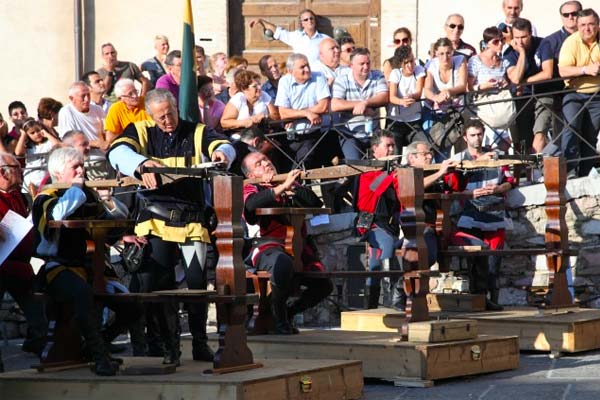
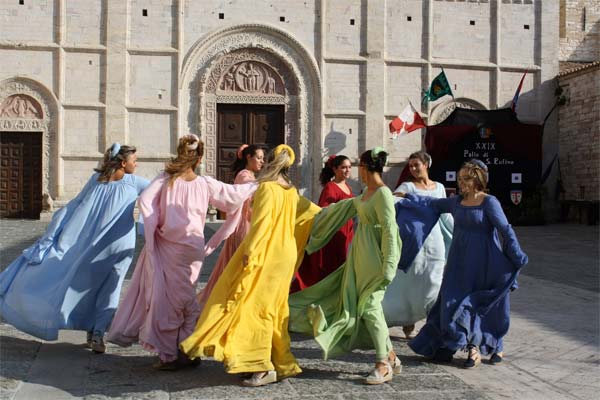
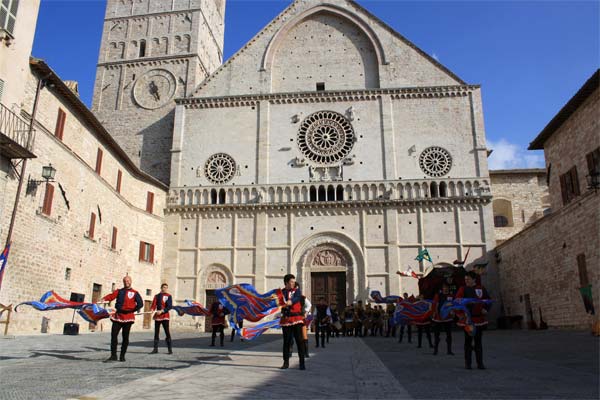
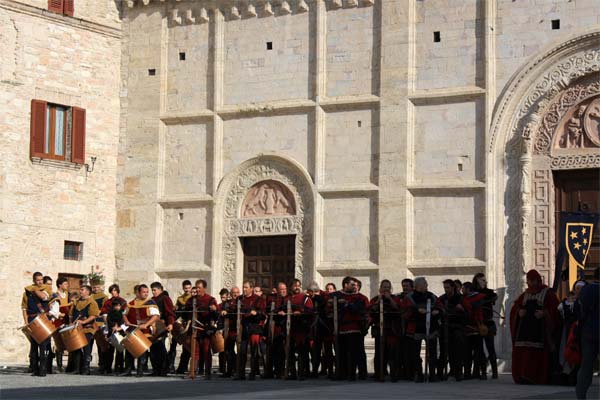
The Compagnia Balestrieri di Assisi was founded on June 29, 1980, reviving the art of crossbow shooting, which for centuries guaranteed municipal freedom, and reviving the tradition of this deadly weapon for the purpose of bloodless entertainment.
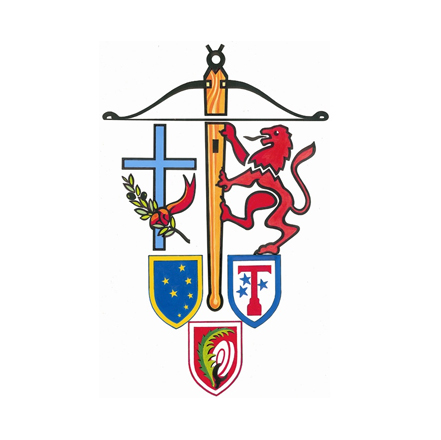
The banner is quartered, with the Guelph lion of Assisi on a red field and a rose of verrette and crossbows on a blue field.
It is one of the founding companies of L.I.T.A.B. and consists of over sixty crossbowmen, a procession of splendid ladies and knights, drummers, flag throwers, musicians, dancers, archers, sword dancers, and fire performers, for a total of about two hundred costumed participants.
The tradition of crossbow shooting has been revived in the form of a recreational sporting event, although in the Middle Ages such competitions were an incentive to practice and perfect shooting skills.
A document in Assisi that mentions this dates back to 1452.
During Pentecost, a festival was held that involved the entire diocese and took place in San Rufino on the occasion of the First Communion of the children of the parishes. For the occasion, a Palio was held between the crossbowmen and the winner received rich prizes.
However, there are also other documents that mention crossbow competitions in Assisi dating back to 1319, where, among other things, it is written “stabilito che nessuno osi con qualche arco o balestra saettare nella Piazza di San Francesco”. (“It is hereby decreed that no one shall dare to shoot arrows or bolts with a bow or crossbow in the Piazza di San Francesco.”) This tradition is celebrated today on the last Friday, Saturday, and Sunday of August, with the “Palio di San Rufino” beginning with a festival in the square on the previous Saturday, a medieval market skillfully set up in Piazza del Comune and in the most significant adjacent alleys, a commemorative dinner in honor of the hospitality reserved for the crossbowmen of neighboring cities on Saturday with medieval shows, the Palio shooting competition on Sunday, contested between the crossbowmen of the three districts that make up the Compagnia.
The oldest traces of human presence in the Assisi area date back to the Neolithic period.
Numerous archaeological finds indicate that Assisi originated as a small village inhabited by the Umbrians as early as the Villanovan period. The Umbrians had close ties (especially commercial) with their Etruscan neighbors on the western bank of the Tiber, from whom they differed in language and culture.
In 295 BC, with the Battle of Sentino, the Romans definitively imposed their rule over Central Italy. The Umbrian city was named Asisium and was monumentalized starting in the 2nd century BC. In 89 BC, it became a municipium and was an important economic and social center of the Roman Empire. With the collapse of the Roman Empire, Assisi also experienced the dark age of barbarian invasions and, in 545, was sacked by the Goths of Totila. Conquered by the Byzantines, it soon passed under Lombard rule and was annexed to the Duchy of Spoleto, with which it shared its fate until the beginning of the 12th century.
After a period of wars, in 1174 it was besieged and conquered by Frederick Barbarossa, who gave the investiture of the city to Duke Corrado di Lutzen, also known as Corrado di Urslingen: Assisi became an imperial domain, but popular uprisings (1198) soon ushered in the communal era, not without internal struggles and wars with neighboring Perugia. Between 1181 and 1182, Francis was born in Assisi, the son of Pietro di Bernardone and Madonna Pica. He was the future saint who, through his work, would leave his mark on the history of the place and of humanity.
During the latter part of the first half of the 13th century, Guelph Assisi suffered several sieges by Saracen and Tartar troops belonging to the great army of Frederick II of Swabia. In the years that followed, Assisi saw the Guelphs and Ghibellines take turns controlling the city. Subsequently, the city came under the rule of the Church, the Perugians, Gian Galeazzo Visconti, the Montefeltros, Braccio Fortebraccio da Montone, and finally Francesco Sforza.
In November 1442, Assisi, defended at that time by Alessandro Sforza, was besieged by troops commanded by Piccinino. After many days of futile attempts, the besieging troops, thanks in part to the help of a traitorous friar, managed to penetrate the city walls.
Assisi was heavily devastated and pillaged, but Piccinino opposed the complete destruction of the city, refusing the 15,000 florins offered by the Perugians. The Sopra faction (aligned with the Ghibellines) and the Fiumi faction (of the Parte de Sotto linked to the Guelphs) fought each other until the 16th century, when Pope Paul III’s conquest of Umbria restored peace and tranquility to the city.
At the height of its municipal splendor, it was torn apart by struggles between the Parte de Sotto, linked to the Guelphs, and the Parte de Sopra, aligned with the Ghibellines, who fought each other until the 16th century.
To put an end to these internal struggles, Governor Andrea Cruciani divided the city into three districts, which were named after St. Francis, St. Rufino, and Divine Marie. To commemorate this historic decision, every year during the last week of August, the Compagnia Balestrieri (Crossbowmen’s Guild) holds a competition between the districts called the “Palio di San Rufino.”
In the Middle Ages, on August 2, the feast day of the patron saint San Rufino, the Palio della Balestra (Crossbow Tournament) was held in the churchyard of the Duomo. Records of this event date back to 1452, with crossbowmen participating from neighboring towns such as Borgo San Sepolcro, Gubbio, Iesi, etc.
Headquarters
Piazza del Comune
06081 Assisi (PG)

