
DATE OF FOUNDATION
2016
MEMBERSHIP OF LITAB
2016
PRESIDENT
Silvano Pelosi
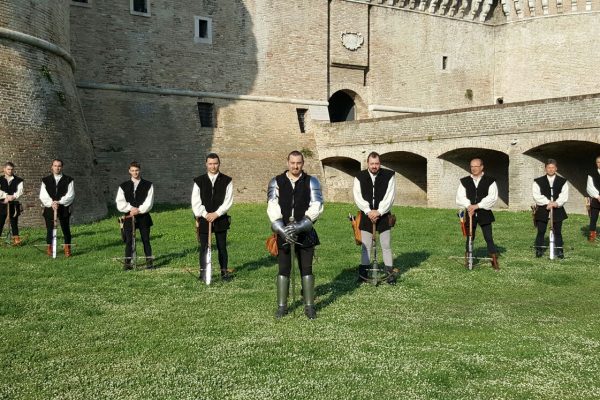
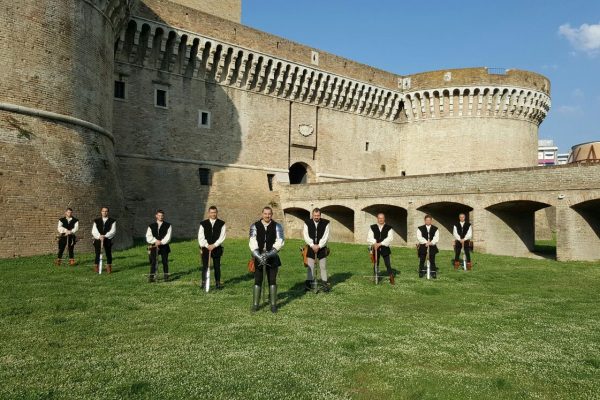
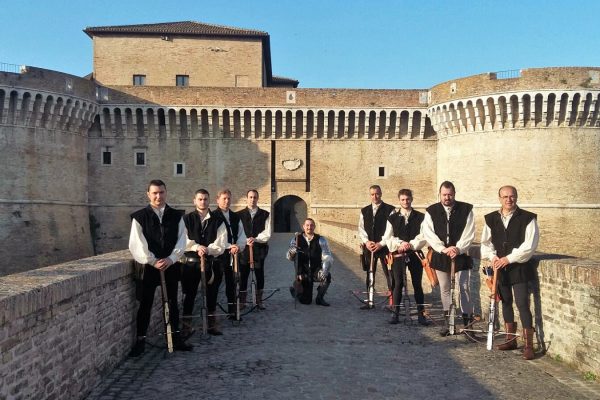
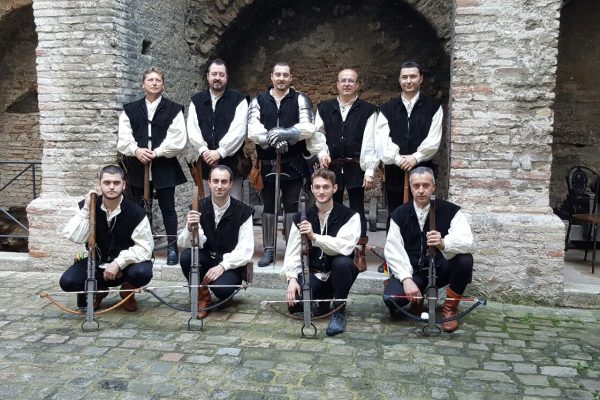
The association promotes and disseminates the activities of historical crossbow shooting, historical archery, knife throwing, and sword fighting.
During events (both historical and otherwise), it offers a representation of a 15th-16th century camp belonging to one of Giovanni della Rovere’s many military units. Inside, visitors have the opportunity to try their hand at archery, crossbow shooting, sword fighting, and knife throwing.
During historical reenactments, the association offers demonstrations of precision shooting with bows, crossbows, and sword fighting.
The city of Senigallia was founded between 389 and 383 BC by the Senones Gauls led by Brennus, who probably settled there because of the conformation of the place.
The city was originally built on a hill overlooking the surrounding ford, which made it a strategic point for sighting and defending against enemies. Senigallia, described by historians as the “capital of the Gauls in Italy,” as Senigallia was defined by historians, was “refounded” by the Romans after the battle of Sentino in 295 BC, in which Rome took possession of Etruria, Umbria, and the territory between Ariminum and the Esino River (Ager Gallicus). It was then that the city was renamed Sena Gallica.
The Roman period saw the city’s population grow, becoming one of the driving forces from an economic and military point of view (the colony of Senigallia made a strategic contribution during the Battle of Metauro in 207 BC).
After the Sack of Rome by the Visigoths in 400 AD and the Sack of Rome in 410 AD, the city came under Byzantine rule (after the fall of the Western Empire in 476 AD with the deposition of Romulus Augustulus).
Sinigallia, as the city was known in the Middle Ages, enjoyed a period of peace and prosperity that lasted until the 13th century, when, following clashes with the cities of Fano and Jesi and the wars between the Ghibellines and Guelphs, the city was stripped of its riches and its imposing defensive structures, including its mighty walls, which were demolished by Manfredi di Hohenstaufen (of Sicily).
The city was revived at the behest of Pope Gregory XI, who commissioned Cardinal Egidio Albornoz to consolidate the temporal power of the Church in the Papal States. After the Avignon Captivity (13 Egidio Albornoz to consolidate the temporal power of the Church in the Papal States. After the Avignon Captivity (1309-1377), he had the demolished walls rebuilt and the defensive structures reinforced (including an imposing Roman tower between the Misa River and the Penna Stream), giving the city a new lease on life.
This new vitality was consolidated with the rise to power of the Malatesta family, lords of Rimini, and in particular Sigismondo Pandolfo Malatesta, the Wolf of Rimini, who opted for a policy of repopulation and reorganization of the city.
It is 1450 and Malatesta is at the height of his power. His personal domains extend from Rimini to Senigallia. In fact, he has already conquered Fano, Pergola, and Mondavio some time ago, and even though Pesaro eludes him, his dominion is almost absolute, thanks in part to decisive victories against the Aragonese army and Federico da Montefeltro.
However, Nova Civitas was also coveted by the della Rovere family, an important Genoese dynasty which, with the appointment of one of its members, Sixtus IV (born Francesco della Rovere), as Peter’s successor, made no secret of its political and military ambitions. Sixtus IV’s goal was to place his nephew Giovanni della Rovere at the head of the neighboring territories of the Duchy of Urbino.
Sisto IV’s ambitions spared Fano and Jesi, but not Mondavio and Senigallia, which were linked to each other for socio-political reasons.
In 1474, he stayed at the sumptuous residence of Giuliano della Rovere, brother of Giovanni and future Pope Julius II. The pope appointed him “Gonfaloniere of the Holy Roman Church” and Duke of Urbino, all in exchange for the hand of his daughter Giovanna Feltria, who would marry Giovanni della Rovere. Having resolved the Montefeltro issue, Sixtus IV arranged the marriage between the young couple, who would actually marry only years later. Sixtus IV invested Giovanni della Rovere with the Lordship of Senigallia and the Vicariate of Mondavio.
The 25 years of the first Rovere’s rule were the most prosperous for the Signoria of Senigallia. The influx of money was unprecedented, the troops serving Giovanni della Rovere were extremely loyal and all came from the territory of the Signoria and the Vicariate. The bulk of the army was stationed in Senigallia to defend the city. Della Rovere, who had been invested with the title of Duke of Sora and Arce and then Praefectus Urbis following the death of his cousin Leonardo, continued his militancy in the Compagnia Feltresca, directing military operations. following the death of his cousin Leonardo, with the title of Duke of Sora and Arce and then Praefectus Urbis, continued his militancy in the Compagnia Feltresca, directing military operations for his father-in-law, leading his own militias, defending the Church and the territories of the Signoria of Senigallia, the Vicariate of Mondavio, and the Duchy of Urbino.
The opulence of the Della Rovere family and the grandeur of the city are evidenced by the construction of the majestic Rocca Roveresca fortress.
The Rocca Roveresca in Senigallia is one of the most significant examples of 15th-century military architecture. Its construction began in 1476, when Duke Giovanni della Rovere commissioned architect Luciano Laurana, who was working for the Duke of Urbino, to redesign the rooms of the previous Malatesta tower built on the ruins of the 14th-century Albornoz fortress and the earlier Roman tower.
The renovation work on the tower, which was to be converted into an emergency ducal residence and shelter for troops, was completed in 1480, the year in which the military architect Baccio Pontelli began construction of the defensive section.
Construction was finally completed in 1482, although the “insignia” had already appeared on the fortress in 1479: “IO DUX-IO PRE,” meaning “IOANNES DUX (SORAE ET SENOGALLIAE) – IOANNES PRAEFECTUS URBIS” (Giovanni Duca of Sora and Lord of Senigallia – Giovanni Prefect of Rome).
The imposing central bastion was surrounded by sturdy walls, and four cyclopean circular towers were built on either side of the quadrangular structure. The fortress was connected by underground passages to the Ducal Palace and by a drawbridge to the square in front of it.

