DATE OF FOUNDATION
XXXX
MEMBERSHIP OF LITAB
1999
PRESIDENT
Tacconi Riccardo
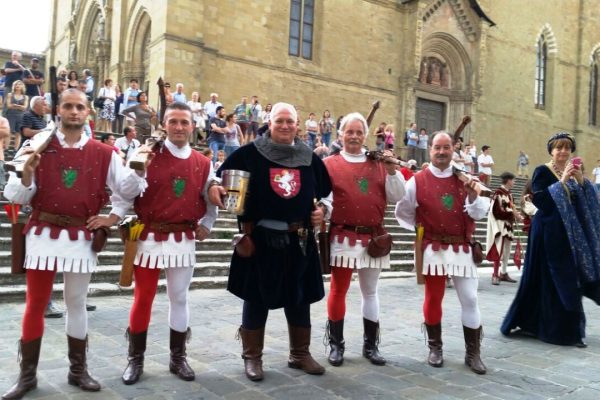
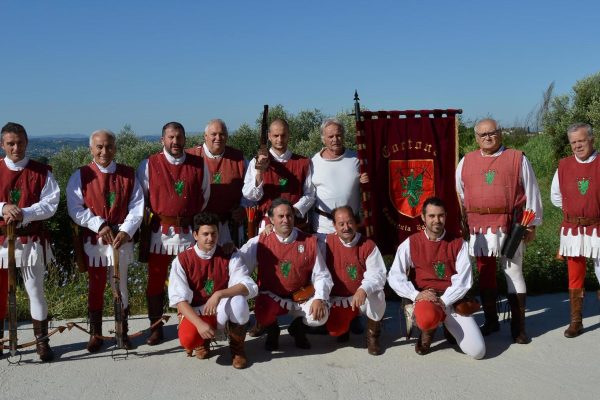
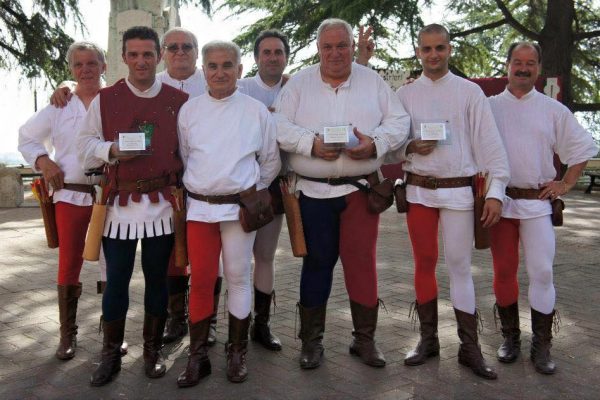
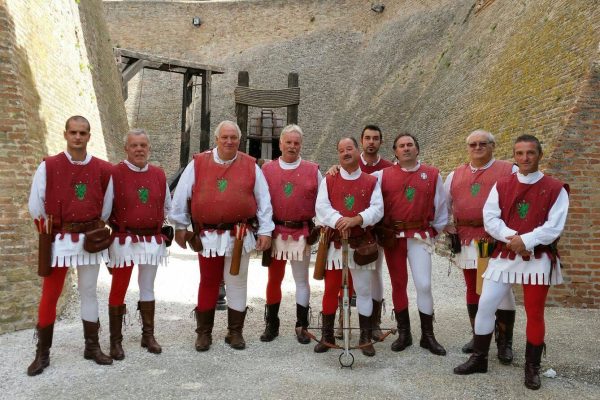
The Compagnia Balestrieri practices the ancient discipline of archery and, using traditional light crossbows, performs with great precision and spectacular skill, hitting targets placed 20 meters away from the archer. The company was formed to compete among the “Quintieri Cittadini” (city districts) during the “Giostra dell’Archidado” tournament.
Over time, the discipline became popular and established itself among the citizens of Cortona, to the point of becoming a source of challenge and competition with other cities that practice the same discipline.
There are no documents attesting to the presence of this weapon in tournaments and wars in Cortona, but we can indirectly trace the use of the crossbow in our city in the Middle Ages from reports of the participation of 1,300 armed men under the command of Uguccio Casali in the Battle of Montaperti in 1300. In Lippo Vanni’s fresco, located in the Civic Museum of Siena, depicting the Battle of Asinalunga, in which Francesco Casali was one of the commanders of the Sienese troops, crossbowmen can be seen; historical references report that about 800 of them were from Cortona.
Finally, in the document dated September 10, 1400, which records the first Palio della Balestra in Sansepolcro, we learn that two crossbowmen, who had come on horseback from Cortona, took part in the same palio.
It is affiliated with the Lega Nazionale Tiro alla Balestra (L.I.T.A.B.), in which it participates in national tournaments alongside other cities that practice the same discipline.
Our Crossbow Company won the Italian Championship of Shooting with the Ancient Manesca Crossbow in 2003, 2006, and 2007.
The city that Virgil wanted to be founded by the mythical Dardanus was probably a fortified city of the Umbrians, which passed to the Etruscans between the 8th and 7th centuries BC, becoming an important Lucumonia. It received Roman citizenship during the Social War, after which there is no further reliable information about it. Cortona flourished during the communal period and then under the rule of Ranieri Casali. Sold by the King of Naples to the Florentines in 1411, it has since followed the fortunes of the Grand Duchy of Tuscany. Built on the spur of Mount Sant’Egidio, Cortona is surrounded by mighty walls smoothed by the centuries and the wind, in which the ancient gates open onto the roads that climb up from the plain.
Visitors looking out from the top of the walls will see one of the most expansive and harmonious panoramas in Italy: the fertile and immense Val di Chiana, enclosed on the horizon by the mountains of Siena, among which Amiata and Cetona stand out, and closer by, the great mirror of Lake Trasimeno. Numerous tombs have been discovered in the countryside below. Among the most famous are those known as the Tanella di Pitagora, the Melone di Camucia, and those of Sodo. The MAEC Etruscan Academy Museum in Palazzo Casali houses a wealth of artifacts, including the famous Etruscan chandelier from the 5th century BC.
The Medici Fortress of GIRIFALCO dominates the top of the hill, below which shines the rebuilt Sanctuary of Santa Margherita, from which the steep, paved streets of the town descend, lined with many beautiful medieval and Renaissance buildings. There are many splendid churches, from the Romanesque-Gothic S. Agostino and S. Francesco to the Renaissance jewels of S. Maria delle Grazie al Calcinaio and Santa Maria Nuova, and the quiet church of S. Niccolò. Cortona was the home of painters Luca Signorelli and Pietro Berrettini, known as Pietro da Cortona. Gino Severini was also born here. The city’s exceptional artistic heritage is preserved in the Diocesan Museum, where the most famous work, Beato Angelico’s Annunciation, takes pride of place. Others can be admired in the Etruscan Academy Museum in Palazzo Casali and in various churches. Finally, the Municipal Library and the Etruscan Academy Library, rich in parchments, manuscripts, incunabula, and printed volumes, are famous among scholars from all over the world.
Headquarters
Via Di Fortezza
52044 Cortona, AR

