DATE OF FOUNDATION
2001
MEMBERSHIP OF LITAB
2001
PRESIDENT
Mauro Cicilloni
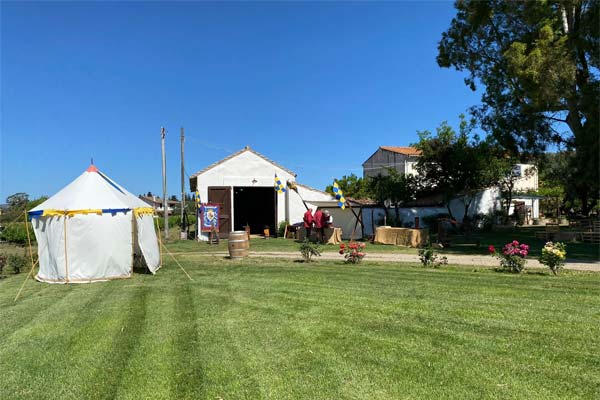
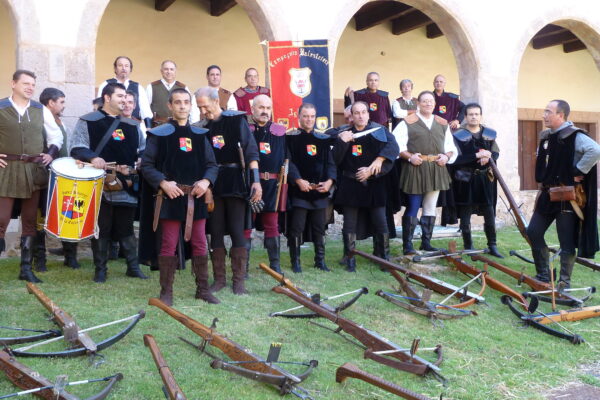
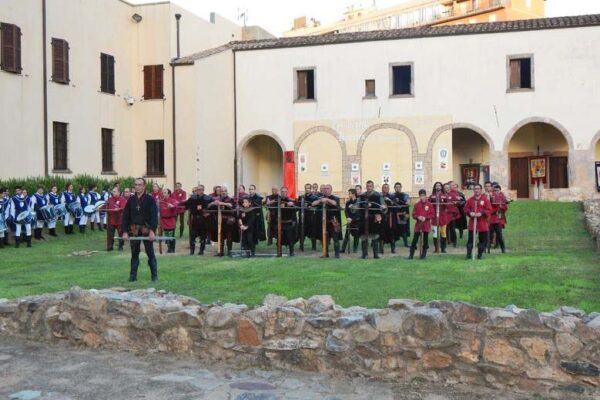
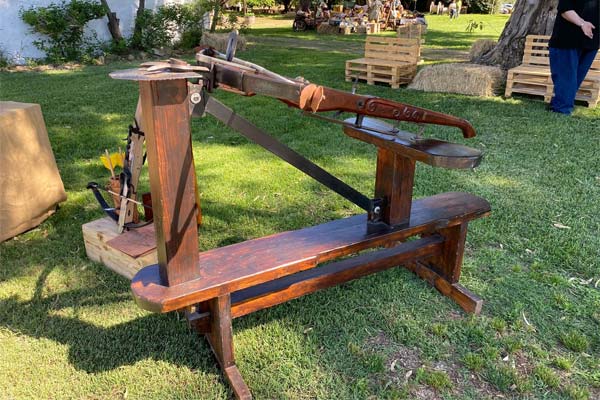
The Compagnia Balestrieri Iglesienti was founded in 2001 thanks to an agreement that allowed the city of Iglesias to be accepted into LITAB, between the two official crossbow companies present in the city, the Società Balestrieri Villa Ecclesiae and the Associazione Balestrieri di Iglesias, with the Associazione Culturale “Società Quartieri Medioevali Villa Ecclesiae” as the owner and organizer of the Iglesiente Medieval Summer from the last Saturday in July to August 13 each year.
The Company consists of about forty crossbowmen who compete every first Saturday in August in the “Torneo della Balestra Città di Iglesias” (City of Iglesias Crossbow Tournament). The event takes place every year during the Iglesiente Medieval Summer, commemorating the exploits of the 150 crossbowmen who, as reported in the “Breve di Villa di Chiesa” and in historical documents of the time, strenuously and successfully defended the walls of the ancient “Villa di Chiesa” until 1324, when they surrendered to the Aragonese with military honors. In the Crossbow Tournament, the crossbowmen of Iglesias compete in four teams representing the four historic districts (Castello, Santa Chiara, Fontana, and Di Mezo) that made up ancient Iglesias.
Membership in the Lega Italiana di Tiro alla Balestra was formalized in 2002, the year in which the Company participated in its first National Championship in the city of Amelia.
Since its establishment, the Compagnia Balestrieri Iglesienti has always participated regularly every year in the Italian Championships organized under the auspices of LITAB.
The Compagnia Balestrieri Iglesienti organizes and manages historical and cultural events on behalf of public administrations and organizing committees for various occasions, festivals, and celebrations.
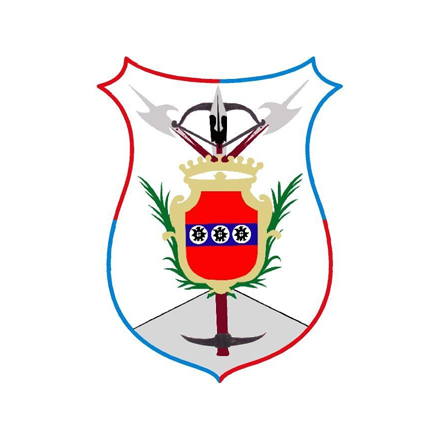
The C.B.I. can provide crossbowmen, archers, armed men, extras, and musicians for performances involving ancient bench crossbow shooting, ancient hand crossbow shooting, medieval archery demonstrations, medieval fencing combat, historical parades, and reenactments of documented historical events. The symbol of the Company in the center has the royal coat of arms of the City of Iglesias with the crossbow and weapons in its defense above it, and below, enclosed in a silver triangle, a pickaxe symbolizing the ancient exploitation of the important silver mines, all enclosed in a shield with edges outlined in red and blue, the official colors of the city.
Iglesias is located in southwestern Sardinia, in the vast territory known as Sulcis Iglesiente, which includes the wide and fertile valleys of Cixerri. Inhabited since ancient times, its municipal area contains 95 archaeological sites, spanning a period from pre-Nuragic to medieval times, continuing through to the modern and contemporary era. This leads us to believe that the continuous presence of man is mainly due to the richness of the subsoil.
The oldest evidence of human presence in the Iglesiente area dates back to the Neolithic period. Human bones have also been found from the Bronze Age, along with ceramic fragments and other metal objects.
The presence of Phoenicians (600 AD) and Carthaginians (700 AD) has been confirmed, and Roman remains are very common. The history of Iglesias has always been closely linked to mining: the Phoenicians, Punics, and Romans were very interested in the intensive exploitation of these riches, and with the decline of Rome, the entire mining region fell into crisis.
It was not until after the year 1000 that interest in mining was revived by the merchant society that relied on the maritime republics. The name of the city of Iglesias was initially Villa di Chiesa, and also Villeclesia.
With the new buildings, churches sprang up in such large numbers that they gave the town its name. The population quickly grew so large that the town was considered one of the most important in the Giudicato of Cagliari. At the height of the Italian maritime republics, the town was called Villeclesia Argentaria. The Pisans added the second name not so much because of the abundance of silver, but because the lead that was mined there at the time was called argentiere.
Until recently, it was believed that Iglesias was founded in 1272, based on a document believed to be the oldest in existence, kept in the Church of San Lorenzo in Genoa. However, there is an older document dating back to 1218 in which Pope Honorius III mentions the great Monastery of San Saturno. The Monastery of San Saturno, now the Sanctuary of the Madonna delle Grazie, is located on top of a hill, entirely built up, in the historic center of Iglesias.
The historic center, enclosed within walls with 22 towers (built during the rule of the Donoratico della Gherardesca counts), is still one of the most remarkable in Sardinia, with its beautiful churches, palaces, and characteristic alleys, dominated by the Rocca Salvaterra fortress. Inside the walls, we also find the Cathedral of Santa Chiara, built by Count Ugolino della Gherardesca, and the Church of San Francesco, while outside the walls there are other ancient places of worship, such as Sant’Antonio Abate (10th-11th century), Nostra Signora di Valverde (12th-13th century), and SS. Salvatore (9th-10th century).
Iglesias, a free municipality and royal city of Sardinia, is currently the provincial capital. It has a population of around 29,000, most of whom work in industry, services (schools, banks, hospitals, offices, etc.), agriculture and sheep farming, crafts, and commerce.
The ancient jewelry is particularly unique, as Iglesias was the home of Sardinian goldsmithing and silversmithing.
Around Iglesias, we can admire the splendid countryside, the stunning Marganai nature reserve and the picturesque Lake Corsi, the beautiful coastline of Iglesias with the Faraglioni di Nebida and its breathtaking views, the fantastic Faraglione di Pan di Zucchero and countless unspoiled coves and inlets. One of the most spectacular tourist attractions are the excursions and guided tours of some of the abandoned mine tunnels, which attract thousands of tourists with their captivating routes.
Headquarters
Via Giuseppe di Vittorio 3
09016 Iglesias (CI)

