TECHNICAL REGULATIONS FOR HAND CROSSBOWS
Art. 1
These regulations apply to the use of antique hand crossbows in the disciplines of freehand shooting and supported shooting.
Art. 2
The LITAB Executive Council establishes that the NATIONAL TOURNAMENT of ancient hand crossbow shooting shall be held every year.
The Tournament shall be organised on a rotating basis for one (1) year, on a date to be determined at the autumn meeting, upon proposal by the organising company. It is not mandatory to organise the Tournament in the city of origin.
Art. 3
All crossbowmen registered with companies belonging to LITAB may participate in the National Tournament of Ancient Hand Crossbow Shooting, provided that they are in good standing with their insurance coverage and annual membership fees and have complied with the checks in accordance with the procedures set out in Articles 4 and 5 of these regulations.
Art. 4
a) The LITAB crossbow must be of the ‘Manesca’ type, loaded by hand or by means of a removable crook or lever (goat’s foot). Mechanical loading systems such as jacks or similar devices are prohibited. In addition to the triangular sighting system, it may not incorporate any other sighting systems or references to improve shooting accuracy. Crossbows without a sighting system are permitted. In the freehand discipline, any form of support is strictly prohibited, both for the crossbow and for the shooter. In the supported discipline, the use of a support shield or other adjustable column system is permitted, but only in height.
b) The bow must be made of a single piece of steel, with a maximum cross-section of 50 x 10 mm and a maximum length of 90 cm. It must be equipped with a safety device called a bow guard, made of sheet steel or leather and laces, provided that they are integral.
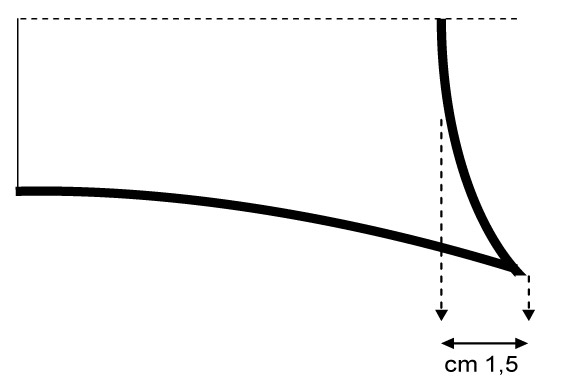
c) The crossbow shaft (or teniere) must be made from a wooden beam with a maximum length of 110 cm and no less than 60 cm. The thickness must not exceed 6 cm. The height of the shaft must never exceed 10 cm (this measurement is not to be understood as the minimum and maximum overall height of the teniere, but as a measurement that can be taken at any point along the length of the shaft). The shaft may be made from a single piece or from boards joined lengthwise, as reported in numerous historical documents. The shape and style of the stock must be reminiscent of the ancient Italian crossbow. No transverse joints may be made on the stock, nor may any supports be applied that facilitate the crossbow’s aiming and shooting. No fixed or movable appendages (hand rests or underarms) may be applied to provide additional shooting assistance. The stock of the crossbow may be lengthened to customise the frame to the shoulder of the crossbowman using it. The end of the stock may be curved, provided that the curvature does not exceed 1.5 cm (see figure).
The “Teniere” may be decorated with figures, friezes, and engravings, provided that these do not aid aiming and/or constitute an additional reference point for the crossbowman (concealed aiming aids). Studs and/or decorative accessories may be applied, provided that they are made from traditional materials of the period and are not contemporary.
d) The front (distal) sighting device must be of the fixed plate type with or without an interchangeable sight plate (not replaceable or manoeuvrable on the shooting platform) and without any possibility of adjustment. The sights may be identified by initials, nicknames, numbers, or various colours or materials. Lighting systems, painted holes, fluorescent lights, graph paper, and coordinates of any kind are prohibited.
e) The rear (proximal) sighting device must be of the fixed type, without adjustment screws. The length of the hole or thickness must not exceed 10 mm, including any countersink or flaring. Lenses, diopters, reticles, fluorescent devices and sun visors may not be placed on the device to improve sighting.
f) The crossbow release lever must not have any screw adjustments that could increase and/or decrease the effectiveness of the lever’s fulcrum point on the release nut pin. The release lever pawl must have a support of at least 2-3 mm in height on the nut pin. The measurement of the pawl’s fulcrum point may be checked by the jury and/or the field judge at any time during the competition, using a gauge provided by the organising company.
Art. 5
a) The LITAB-type ‘verretta’ or dart must be made of wood in a single piece with a round section, with a conical steel tip with a maximum length of 80 mm (any other type of tip is prohibited), with fletching (consisting of two horizontal feathers) made of natural materials; plastic feathers are therefore prohibited. It may have only one reference point for aiming (a small nail on the ogive) and, if entirely painted, it must have a clean, unpainted area from which the material of construction can be determined. It must not exceed 50 cm in length, with a minimum ogive diameter of 18 mm and a maximum of 22 mm.
b) The name or nickname of the crossbowman and the company to which he belongs must be clearly legible and identifiable on the bolt, under penalty of cancellation of the score obtained during the competition.
c) The verification of the conformity of the bolts used takes place at the end of the competition (during the check) and will be carried out on all the bolts used by the winning team and the first-ranked crossbowman. The bolts are validated during the reading and validation of the scores. Only if all the bolts examined are compliant will the result be approved.
d) If the team or crossbowman checked is found to be non-compliant, they will be disqualified and the next team or crossbowman will be checked.
Art. 6
The crossbow must be available for inspection by the Jury on the day of the tournament, before the test shots, and must be available for inspection during the competitions and in any case until the results are made official.
Art. 7
There are two types of LITAB-approved targets:
a) flat targets valid for team and individual competitions (quadrello), which must be made of plywood, with a thickness varying from 4 cm to 6 cm, square in shape with dimensions of 33 cm x 33 cm, suitable for holding L.I.T.A.B. approved targets with concentric circles ranging from 30 points to 2 points. (as per the attached sample).
b) ‘corniolo’ or ‘tasso’ valid for individual competitions, consists of a wooden base, circular or square in shape, with a thickness varying from 4 cm to 6 cm, with a diameter or side of at least 40 cm; in the centre of which is placed a corniolo or tasso, truncated cone-shaped, with a total length of 50 cm and a diameter at the top of 17 cm. The central part of the printed sign, described in point a), must be glued to the top of the corniolo, so as to include the circle with a score of 16. The target wheel at the top of the cornel tree must be made of plywood with a thickness varying from 4 cm to 6 cm. The whole thing must be fixed to the body of the cornel tree with a metal band of appropriate diameter. Reference marks and objects placed on the target that could assist the crossbowmen in aiming are prohibited (only drawings, coats of arms and artistic inscriptions for decoration are permitted).
Art. 8
The targets must be placed at a distance of 20 metres from the firing line and at a height of 2 metres from the firing plane. Any changes must be agreed with the LITAB board at the autumn meeting and, in any case, must be between 18 and 30 metres in distance and between 2 and 7 metres in height from the firing plane.
Art. 9
The shooting ranges must be at least 1.20 metres wide for hand crossbow competitions and at least 1.50 metres wide for competitions with hand crossbows with supports; they must be delimited at the front by a suitable balustrade between 90 and 110 cm high for hand shooting competitions.
The layout and shooting sequence will be decided by drawing lots on the day of the competition, before the start of the practice shots, at a time set by the organisers and in the presence of all the companies. The shooting order and sequence shall be decided by drawing lots on the day of the competition, before the start of the trial shots, at the time established by the organisers and in the presence of all the companies. If there are late arrivals, the draw shall be carried out at the established time by simple majority.
Art. 10
a) The shooting procedure will be supervised by a field judge, who, after ensuring that the shooting area is completely safe, may give the order to attach the string to the nut. At that point, each crossbowman may begin their shooting sequence until all possible shots have been taken.
b) A shot is considered to have been made and is valid if the bolt is fired, released or falls from the crossbow, under any circumstances. If the bolt falls and is within a radius from which the crossbowman can pick it up without moving, the shot may be repeated, but only at the end of the volley.
c) The shooting position may only be abandoned after all crossbowmen in position have completed their shooting sequence.
Art. 11
Regardless of the score achieved, if an arrow falls from the target during the competition, the shot shall be considered invalid.
Art. 12
In the event that the wooden part of the dart detaches from the tip and the tip remains stuck in the target, the shot is considered valid for all purposes and therefore approved for the score obtained, provided that the tip can be identified with certainty.
Art. 13
If an arrow, or part of it, sticks into another arrow, the score obtained is equal to that of the first arrow stuck in the target. In individual competitions, it is ranked immediately after the first bolt in the ranking; this also applies to any other bolts that may stick into the first two. The single body that is formed remains the property of the last crossbowman to release his bolt.
Art. 14
Once the competition is over, the verification of the shots, relative scores and the verification of the targets takes place in the presence of the Masters of Arms and the Captains, who have been paired together beforehand by drawing lots. The master-at-arms, at the invitation of the Field Judge, will remove the target of his team and will also be the one to call out the points scored by his arrows in the closed park, under the supervision of the captain paired with him. In the event of a violation of this Article, a penalty of 30 points will be applied to the team.
Art. 15
If there are grounds for dispute, the arrows in question must not be removed from the target for any reason, under penalty of being awarded a lower score. Disputes must be reviewed and decided by a simple majority of the tournament jury, composed of all the masters-at-arms of the competing companies.
Art.16
The dart that marks the target card is considered valid. If a dart is on the dividing line between the target circles, the higher score is taken into consideration.
Art. 17
The best shot, in all competitions where this is necessary, is determined by measuring the distance between the perfect centre of the target (spillo) and the side of the tip closest to it. In the event of a tie, the clockwise rule is applied, taking 12 o’clock as the best reference point; a dart at 1 o’clock is better than a dart at 11 o’clock.
Art. 18
The National Tournament is contested by teams composed of 8 (eight) competing crossbowmen and 1 (one) reserve for the team competition; while for the individual competition, the number of crossbowmen competing may rise to the maximum number of shooting positions available. In the event of a challenge to the corniolo, the number of crossbowmen per team may be further increased.
If a team arrives at the Tournament with fewer participants, it may still compete, but without any additional help.
Art. 19
Upon accreditation, the Master-at-Arms of each participating company must present, in addition to the receipt certifying payment of the annual L.I.T.A.B. membership fee and receipts certifying insurance coverage for the crossbowmen competing, a list with the names of their competing crossbowmen, in addition to his own and that of the Captain. For the team tournament list, it will be possible to wait for the results of the individual qualifying rounds in the morning.
Art. 20
a) In the team tournament, each participating company will have a single target on which to throw all its darts; if thrown by mistake onto another team’s target, they will not score points. Participants in the team tournament will have three throws each, to be released in sequence.
The team with the highest total score after the points have been counted will be declared the winner. In the event of a tie, the team with the highest number of hits or, alternatively, the best arrow stuck in the centre (see Art. 17) will be declared the winner.
b) Participants in the individual tournament will each have a target at their disposal on which to shoot their darts; if shot by mistake on another participant’s target, they will not score any points. Participants in the individual tournament will have three shots each, to be released in sequence, while there will be more than one round; generally three rounds plus the final round. The crossbowman with the highest total score will be declared the winner. In the event of a tie, the crossbowman with the highest number of hits or, alternatively, the best bolt stuck in the centre (see Art. 17) will be declared the winner.
c) Participants in the Tournament with ‘corniolo’ will have one or two shots each, alternating. The winner will be the person who scores the best shot (see Art. 17).
Art. 21
a) Any crossbowman who, during the competition (on the platform), intends to forfeit their shot must raise their right hand to be replaced (by the reserve). They may leave the platform at the end of the other competitors’ shots and their replacement may compete alone at the end of the competition.
b) In the event of a technical incident, the crossbow may be replaced in the individual tournament and the archer or crossbow may be replaced in the team tournament.
c) If the lever is released during the loading phase, it may be replaced as soon as possible in order to continue the competition.
Art. 22
Participants are prohibited from crossing the shooting line and directly gathering information from persons outside the competition area. Each competitor must go to their shooting position carrying their own crossbow. They may not carry special glasses and/or sunglasses, visors, tools, positioning systems, measuring devices or anything else that may aid shooting and aiming. Only prescription glasses with white lenses are permitted.
Art. 23
Each competitor is liable for any damage caused to other competitors’ equipment and must behave in a manner befitting the image of LITAB.
Art. 24
The tournament jury is composed of one Master of Arms for each participating city. The tournament jury will decide on any complaints or disputes by simple majority before approving any final results. In the event of a tie, the additional judgement of the Field Judge will be required. Their judgement is final and cannot be appealed.
Art. 25
Participants are strictly prohibited from approaching the targets and/or judges or interfering with their work in any way, under penalty of disqualification and cancellation of their score.
Art. 26
The tournament judges must verify that the National Tournament is conducted correctly, that the materials are suitable and that the participants are registered with LITAB, under penalty of disqualification of the competitor or competitors.
Art. 27
Any infringement of these rules may be reported by any competitor to their fencing master, who shall then report it to the tournament jury for appropriate action.
Art. 28
The company organising the National Tournament undertakes to prepare the competition field in accordance with technical safety regulations, to appoint a field judge and to do everything necessary for the draws and the verification of the darts. In the event of adverse weather conditions, it must also provide an indoor shooting range or, in any case, a suitable structure for the proper conduct of the event.
Art. 29
Within the competition area, false targets, telescopes, rangefinders, binoculars, radio transmitters and any other device used to indicate the position of shots and darts on the target are prohibited. Reference marks and all non-regulation objects placed on the scoreboard are considered prohibited, with the sole exception of targets. For this reason, the Company’s coat of arms shall be affixed under its target after the test shots, under penalty of disqualification of that Company.
Art. 30
Penalties are expressed as:
1. Warning;
2. Suspension;
3. Expulsion;
4. Disqualification;
Penalties are progressively more severe and are a direct consequence of the warning and the number of warnings.
1 verbal warning (no penalty);
2 warnings in the same shooting session trigger suspension (all three of the crossbowman’s shots are invalid);
3 warnings in the same tournament trigger expulsion (with all scores totalled by the crossbowman in the individual and team competition being reset to zero);
2 warnings in different tournaments trigger the disqualification of the crossbowman for the next tournament and/or competition;
After the first disqualification during the year, any further warnings will result in immediate disqualification from the next tournament and/or competition;
The decision is taken by a simple majority of the jury before the official announcement of the results, and its judgement is final.
Art. 31
In the event that the competition is postponed due to force majeure shortly before the scheduled date, it is the responsibility of the company organising the tournament to notify all interested parties in writing of the new date.
Art. 32
All Companies undertake to comply with and ensure that their members comply with these technical regulations. They are also responsible for selecting competitors and for checking the safety of competition equipment.
These regulations consist of 32 articles and are valid for all ancient hand crossbow events organised by L.I.T.A.B.
Amended in Cortona on 24 July 2011.

