DATE OF FOUNDATION
1987
MEMBERSHIP OF LITAB
1988
PRESIDENT
Ragugini Stefano
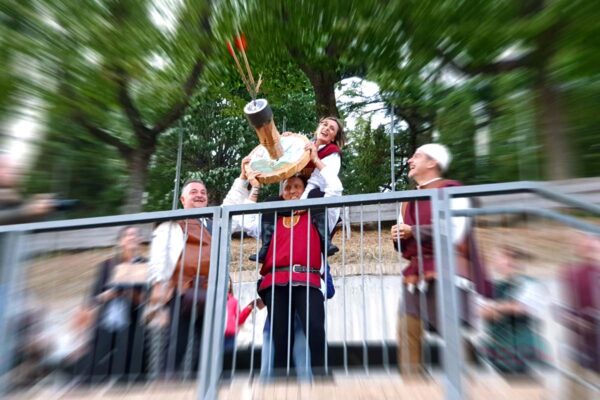
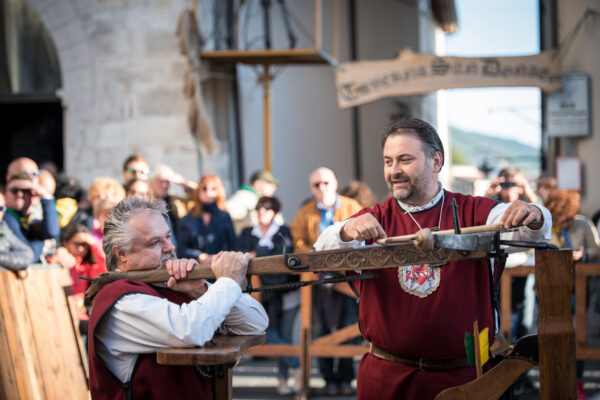
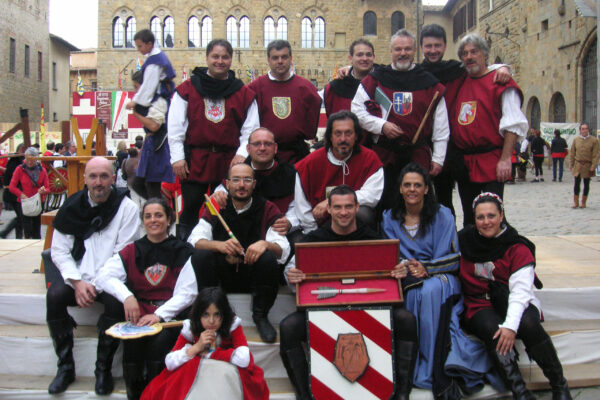
In Gualdo Tadino, the use of the crossbow as a weapon of war has been documented since the end of the 14th century.
In 1393, the venture captain Gualdana di Pietro, hired as Constable by the city of Perugia, led a militia of foot soldiers from Gualdo, which included several crossbowmen.
In the mid-15th century, crossbows for military use are listed in two inventories of the soldiers stationed at Rocca Flea (1455 and 1459): “quindici balestre grosse da molinello […](fifteen large crossbows with windlasses) 1264 verrettuni ferrati […] (1264 iron bolts) doy croci de legne per balestre a bancho […] (two wooden crosses for bench crossbows) quatro banchi forniti da carcare balestre (four benches equipped for loading crossbows)”.
In addition, the treasurer of the Apostolic Chamber provided the city with six florins every six months for the purchase of crossbows and other weapons.
In 1519, a decree issued by the Papal Legate, Cardinal Antonio del Monte, established that part of the proceeds from the Fair of St. Michael the Archangel, held every year in May, would be allocated to the challenge between balisteriis competing for the prize.
It is precisely in the spirit of this challenge that, today, the crossbowmen of Gualdo, every year on the last Saturday of September, during the “Giochi de le Porte” (Games of the Gates), divided into the colors of the four districts (San Benedetto, San Donato, San Facondino, and San Martino), compete for the coveted tournament trophy.
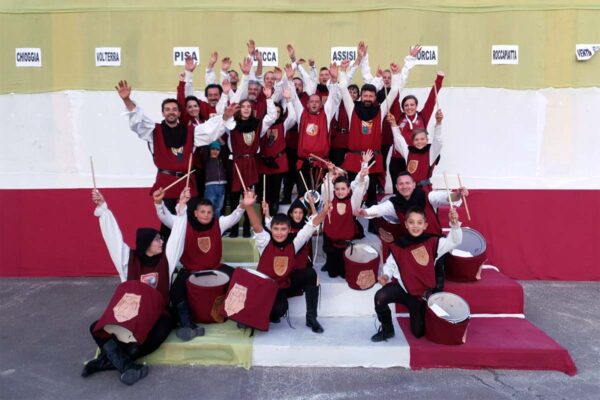
The Crossbowmen Company Waldum was founded on September 22, 1987, by a group of young people passionate about the history of the city and joined LITAB in 1988.
In 1989, he participated in his first national championship.
He organized three Italian championships in Gualdo Tadino in 1990, 2000, and 2010.
Every year, he participates in the national championship and the regional championship.
There are five Umbrian companies in the league:
Amelia, Assisi, Gualdo Tadino, Montefalco, and Norcia.
At the Italian Crossbow Shooting League National Championship held in Montefalco on September 8, 2019, Beatrice Parlanti won the 2019 Italian individual shooting title, coming first out of 156 shooters.
In addition, the crossbowmen from Gualdo came close to the podium, finishing in 4th place in the team competition and setting a record score of 303 points, never before achieved.
Currently, the Company’s Executive Committee consists of President Stefano Ragugini, Vice President Simone Rosi, Secretary Valentina Funaro, Master of Arms Luca Frappini, and Vice Master of Arms Giuseppe Merollini.
Known as Tarsina, it was conquered by Rome and renamed Tadinum. A Roman municipality, it became a thriving city with an urban area covering almost thirteen hectares.
Alaric’s Goths, heading towards Rome in 409 AD, plundered and destroyed everything they found along the Via Flaminia, inflicting the first severe blow in its history. In the 4th century, it was already a bishopric.
Its territory was the scene of the famous Battle of Tagina (552 AD), during which the Byzantine general Narsete defeated the Gothic army led by King Badwila, known as Totila, who lost his life on the battlefield.
A few years later, with the arrival of the Lombards, the Tadino territory became part of the Duchy of Spoleto. Destroyed definitively by Otto III, Holy Roman Emperor, in 996, the city changed its name to the Lombard name Gualdo (wooded place) and its inhabitants took refuge in Val di Gorgo, on the slopes of Serrasanta.
Destroyed by a violent fire, it was rebuilt in 1237 around the Abbey of St. Benedict, on what is now Colle Sant’Angelo (the saint of the Lombards), dominated by Rocca Flea, becoming a free commune under the protection of Frederick II of Swabia. Contested between Gubbio and Perugia, it subsequently submitted reluctantly to Perugia before being handed over to the Papal States by Iacopo P. Canino (1458).
The city was severely damaged in 1751 by a strong earthquake that destroyed most of its late medieval features. The Rocca Flea currently houses a beautiful museum rich in paintings and furnishings, including a famous 15th-century polyptych by Nicolò, known as l’Alunno, and several panels by Matteo da Gualdo.
In 1833, Pope Gregory XVI conferred the title of City on the settlement, naming it Gualdo (Waldum) Tadino (Tadinum), and in 1860 it was annexed to the Kingdom of Italy.
The city boasts significant architectural and historical treasures such as the Rocca Flea fortress, the monumental Church of San Francesco, the Pietro Conti Regional Museum of Emigration, the Casa Cajani cultural center, the Basilica Cathedral of San Benedetto with its outdoor fountain, the Palazzo del Podestà and the Civic Tower, the Church of Santa Chiara, the archaeological excavations of the Roman Tadinum, and the Parish Church of Santa Maria Assunta in Pieve di Compresseto.
Headquarters
Via Giacomo Leopardi
06023 Gualdo Tadino (PG)

